
LeanLaw Reporting Features for Attorneys and Legal Bookkeepers
Jun 17, 2026As a legal bookkeeper, you want to do everything in your power to guide your attorney-client to a profitable law firm and deliver a compliant set of books. And if you are an attorney reading this article, you went to law school to practice law — not to become a business analyst.
The reality of running a law firm is that the numbers matter just as much as the casework. Firms that thrive long-term aren't just winning cases; they're paying close attention to their financial health, their billing efficiency, and where their time is actually going.
The problem? Most attorneys don't have a clear, real-time picture of how their firm is performing. Invoices go out late, trust balances get murky, and cash flow surprises no one in a good way. That's where LeanLaw's reporting features become one of the most powerful tools in your practice. Built specifically for law firms and integrated directly with QuickBooks Online, LeanLaw gives attorneys and firm managers access to the reports that matter most — without needing a finance degree to understand them. Let's break down the key reports, what they tell you, and why you can't afford to ignore them.
Why Reporting Is a Business Imperative for Law Firms
Before diving into the specific reports, it's worth understanding why reporting matters so much in a legal practice.
Law firms face a unique financial challenge: revenue is invisible until it's billed. An attorney can work 60 hours in a week and not collect a single dollar if those hours aren't tracked, invoiced, and followed up on. Unlike a retail business that rings a sale at the point of transaction, a law firm's revenue pipeline has multiple steps — and each step is an opportunity for money to slip through the cracks.
Good reporting closes those gaps. It tells you what you've earned, what you've billed, what you've collected, and what's still at risk. It shows you which clients and matters are profitable and which ones are quietly draining your resources. And in the case of trust accounting, it keeps you legally and ethically compliant.
LeanLaw makes these reports accessible, accurate, and actionable — even for attorneys who would rather be in the courtroom than in a spreadsheet.
The Essential LeanLaw Reports Every Attorney or Legal Bookkeeper Should Be Running
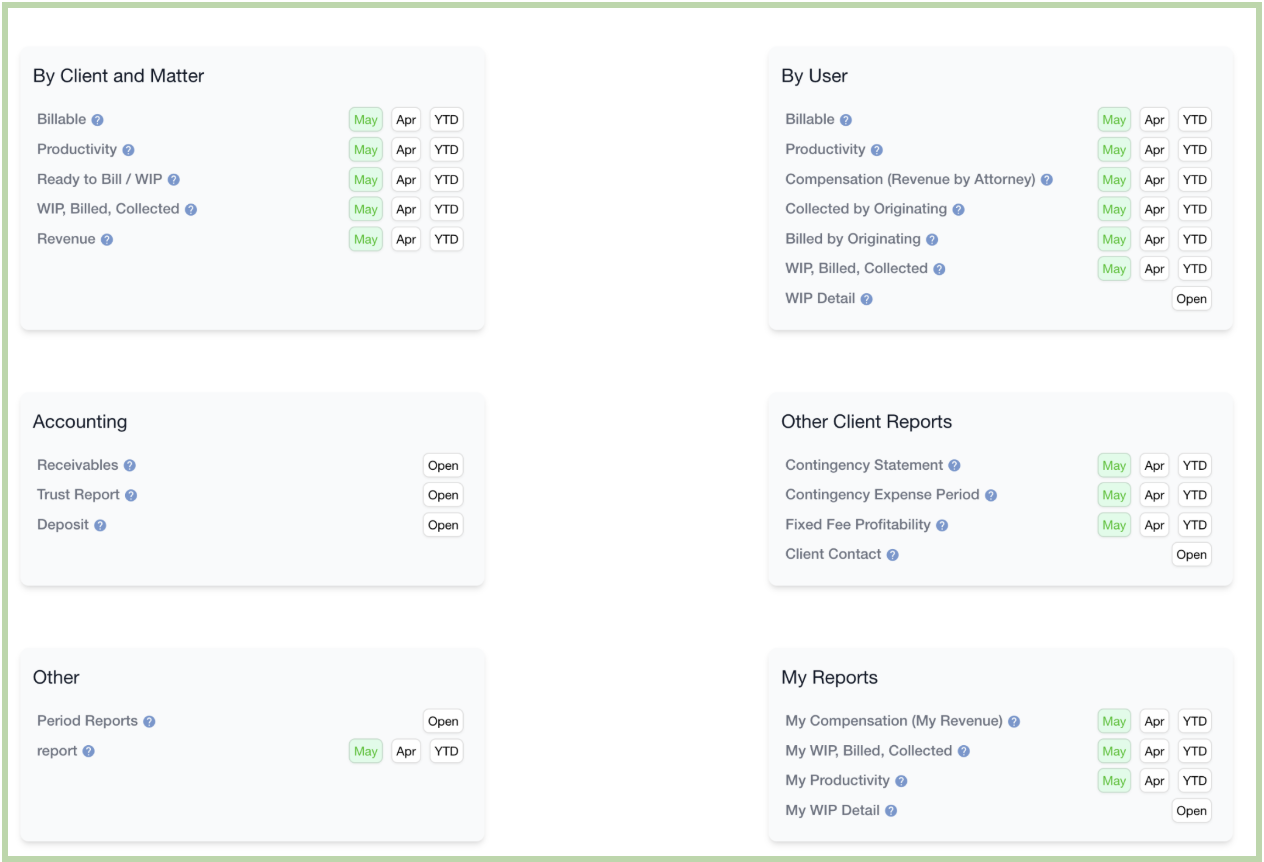
Origination & Billing Attorney Reports
What it shows: Revenue broken down by the attorney who brought in the client (originating attorney) and the attorney who did the work (billing attorney).
Why it matters: This report is critical for law firms with multiple attorneys. It answers questions like: Who is generating the most business? Who is billing the most hours? Are certain attorneys consistently over- or under-performing? If your firm uses a compensation or bonus structure tied to origination or billable hours, this report is the foundation of a fair and transparent system.
For managing partners, it's also a key tool for identifying where to invest in growth — doubling down on rainmakers or developing attorneys who are strong billers but light on business development.
Unbilled Time & Expenses Report
What it shows: All time entries and expenses that have been recorded but not yet included on an invoice.
Why it matters: This is one of the most important — and most overlooked — reports in a law firm. Unbilled time represents work that has been done but not yet converted into revenue. Left unchecked, it can result in thousands of dollars in written-off fees, missed billing deadlines, or awkward conversations with clients about old work.
Running this report weekly or monthly keeps the billing pipeline moving. It also helps you spot attorneys who are great at doing the work but slow to record their time — a pattern that quietly costs the firm money over time.
Attorney Tip: Set a firm-wide policy for how quickly time must be entered after work is performed. Many firms require same-day or next-day time entry. LeanLaw makes it easy to track this discipline through the unbilled report.
Accounts Receivable (A/R) Aging Report
What it shows: All outstanding invoices organized by how long they've been unpaid — typically in buckets of 0–30 days, 31–60 days, 61–90 days, and 90+ days.
Why it matters: Cash flow is the lifeblood of any law firm, and the A/R aging report is your real-time pulse check. It shows you exactly who owes you money and for how long. The older a receivable gets, the harder it becomes to collect — which means the sooner you act on overdue invoices, the better.
This report also helps you identify patterns: Are certain clients consistently slow to pay? Is a particular practice area carrying more aging receivables than others? These insights help you make smarter decisions about payment terms, retainer requirements, and which clients to take on in the future.
Trust Account Ledger Report
What it shows: A detailed transaction history of every trust account, broken down by client and matter — including deposits, disbursements, and current balances.
Why it matters: Trust accounting isn't just good business practice — it's an ethical and legal obligation. State bar associations require attorneys to maintain accurate records of all client trust funds and to reconcile those accounts monthly. A trust ledger discrepancy, even an unintentional one, can trigger a bar complaint, a disciplinary investigation, or worse.
LeanLaw's trust ledger report gives you a complete, audit-ready record of every trust transaction. Running this report at the end of each month — and reconciling it against your bank statement and client ledgers — is one of the most important compliance activities in your firm.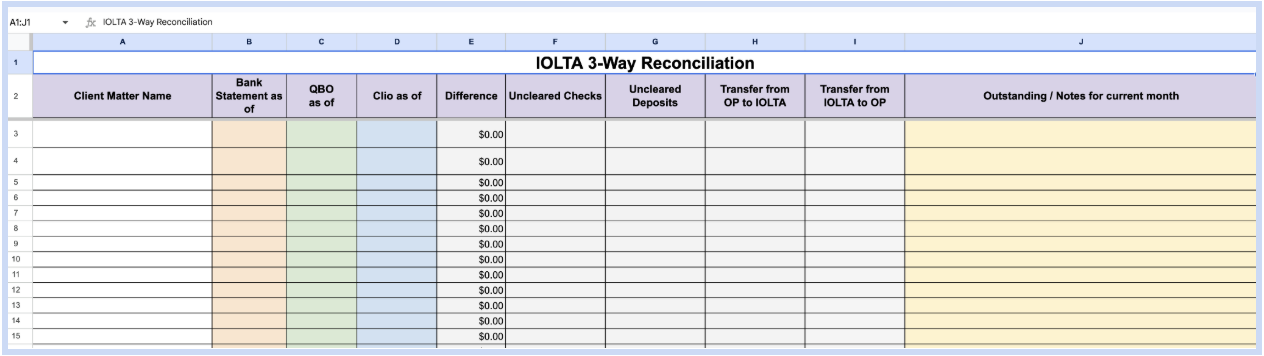
Three-Way Trust Reconciliation Report
What it shows: A side-by-side comparison of three records that must always match: the trust bank statement, the trust account ledger, and the sum of all individual client trust ledgers.
Why it matters: The three-way reconciliation is the gold standard of trust account compliance. Most state bars require it monthly. If these three numbers don't match, something is wrong — and it needs to be found and corrected immediately.
LeanLaw automates the heavy lifting of this report, pulling together all three data sources and flagging any discrepancies. What used to take hours of manual cross-referencing can now be completed in minutes. For any attorney who has ever dreaded reconciliation day, this feature alone is worth the price of the software.
To provide the law firm with a proper three-way bank reconciliation, it should be done in Excel or a Google Sheet. Refer to your client's local bar association for the exact details as to how that report should present itself. Click the link to see ours. You can copy it.
Matter Profitability Report
What it shows: A breakdown of revenue, time invested, and expenses for individual matters — giving you a true picture of whether a case was actually profitable.
Why it matters: Not all matters are created equal. Some clients pay premium rates and resolve quickly. Others are billed at reduced rates, drag on for months, and require extensive resources. Without a profitability report, it's easy to assume a busy practice is a profitable one — but busyness and profitability are not the same thing.
The matter profitability report helps you make smarter decisions about case intake, fee arrangements, and staffing for different matter types. Over time, it reveals which practice areas, client types, and billing structures generate the best return for your firm.
Advanced Dashboards
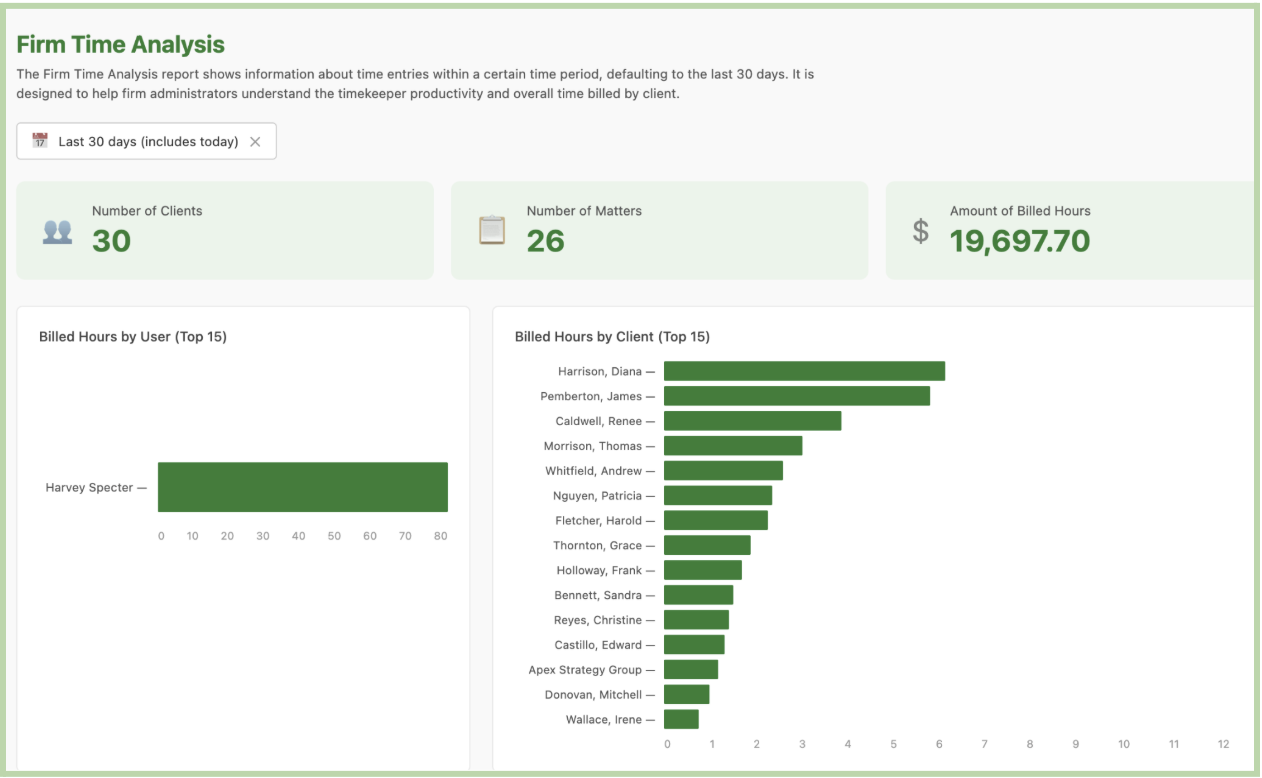
What it shows: The percentage of recorded time that actually gets billed to clients, compared to what was written off or discounted.
Why it matters: Realization rate is one of the most important performance metrics in a law firm, and most attorneys don't track it closely enough. If your attorneys are recording 100 hours but billing only 75 hours of fees, your realization rate is 75% — meaning 25% of your team's time goes uncompensated.
LeanLaw's advanced dashboard can help you create a realization report, which helps you understand where write-downs are happening and why. Are attorneys discounting fees too aggressively? Is time being written off after the fact because it wasn't billed promptly? Are certain practice areas consistently undervalued? This report answers those questions.
Revenue by Practice Area or Client Report
What it shows: A breakdown of total revenue segmented by practice area, client, or matter type over any given time period.
Why it matters: This is your strategic planning report. It shows you where your revenue is actually coming from — and where it isn't. If 80% of your firm's revenue is coming from 20% of your clients, that's both a strength and a vulnerability. If a practice area you've invested heavily in is underperforming, this report surfaces that reality before it becomes a crisis.
Use this report quarterly to evaluate your firm's revenue mix, identify growth opportunities, and make informed decisions about hiring, marketing, and practice development.
Turning Reports Into Action
Reports are only valuable if you use them. Here's a simple rhythm to build into your practice:
Weekly: Run the unbilled time report and the A/R aging report. Follow up on anything overdue and ensure time is entered consistently.
Monthly: Run the trust ledger and complete your three-way reconciliation. Review matter profitability on active cases. Check billing realization rates.
Quarterly: Pull the revenue by practice area report and the origination/billing attorney report. Use these for firm strategy conversations, performance reviews, and compensation planning.
The Bottom Line
Running a law firm without good reporting is like navigating without a map — you might get somewhere, but you're leaving a lot to chance. LeanLaw's reporting suite gives attorneys a clear, real-time view of the financial health of their practice, from trust compliance to strategic profitability.
The best part? These reports are built for attorneys, not accountants. They're accessible, intuitive, and designed to surface the information you actually need to make decisions. You don't have to become a numbers person to run a financially healthy firm — you just have to know which reports to run and what to do with what they tell you.
If you're not already using LeanLaw's reporting features consistently, there's no better time to start than now. Your firm's profitability, compliance, and long-term growth depend on it.
Have a report you rely on that we didn't cover? Share it in the comments — we'd love to hear how attorneys are using data to build stronger firms.
Stay connected with news and updates!
Join our mailing list to receive the latest news and updates from our team.
Don't worry, your information will not be shared.
We hate SPAM. We will never sell your information, for any reason.
